What is bandwidth: a complete guide to understanding internet speed and capacity


Bandwidth is the maximum amount of data your internet connection can transfer in a given period, measured in megabits per second (Mbps) or gigabits per second (Gbps).
Imagine your internet connection as a highway, with bandwidth being the number of lanes on that highway. A wider highway with more lanes can carry more traffic at the same time without causing a traffic jam, while a narrow one can become congested when too many cars are on the road.
The same thing happens with your home network. If one person watches a 4K movie, another joins a video conferencing call, and someone else plays an online game, all those activities use bandwidth.
If your connection has enough capacity, everything can run smoothly. If demand exceeds that capacity, your network can slow down or struggle to keep up.
Understanding how bandwidth works helps you spot how much capacity you leave unused, which matters when you pay for a high-speed plan but only use a fraction of its available bandwidth.
Key takeaways
- Bandwidth measures how much data your connection can transfer.
- High bandwidth or maximum bandwidth does not guarantee fast performance.
- Wi-Fi, congestion, latency, and hardware can affect your actual speed.
- Unused bandwidth can be shared through apps like Honeygain for background income.
- Your provider’s advertised “up to” speed may vary due to infrastructure and local congestion.


What Is bandwidth and how does it work
Bandwidth refers to the maximum rate at which data can move across a network connection. Your internet service provider expresses this capacity in Mbps or Gbps, so a 100 Mbps connection can transfer up to 100 megabits of data per second under the right conditions.
Think of your internet connection like a water pipe. The pipe’s width represents bandwidth, while the water flowing through it represents your data.
A wider pipe can carry more water at once, giving you more capacity, but the width of the pipe alone does not determine how fast the water flows.
The same idea applies to your internet connection: more bandwidth gives you more capacity to transfer data, but other factors affect your actual transfer speed.
Let’s say your internet plan offers 500 Mbps. That’s the maximum amount of data your connection can handle per second under ideal conditions, but you may not actually get 500 Mbps every time you go online.
If you’re far from or have thick walls between you and router, your signal can weaken, which can slow down the connection on your device. Likewise, if your router can’t handle the bandwidth your internet plan provides, you won’t get the full benefit of that 500 Mbps connection.
You also share your bandwidth with everyone else using your network. If you’re streaming music while someone else downloads large files and another person joins a video call, your available bandwidth gets divided between them, so each device has less capacity to work with.
The service you’re using can affect transfer rate, too. If you’re downloading a file from a slow or overloaded server, the download can take longer even when your own internet connection has plenty of bandwidth available.
So, when you see 500 Mbps on your internet plan, think of it as the maximum capacity available to you, not a speed you’ll get in every situation.
Internet speed vs bandwidth: What is the difference
Bandwidth determines how much data your connection can carry, while internet speed determines how quickly that data actually moves.
Bandwidth vs internet speed quick comparison:
| Feature | Bandwidth | Internet speed |
| Definition | The total amount of data your connection can transfer over a given period. | The actual rate at which data travels between your device and the internet. |
| Analogy | You can think of bandwidth as the size of the pipe. A wider pipe can carry more water at once. | Internet speed is the speed of the water flow through that pipe. |
| Primary factor | The capacity of your internet connection and how much data it can handle at once. | Factors such as network congestion, latency, Wi-Fi quality, your router, and the server you connect to. |
| Impact on you | More bandwidth gives you more room to stream, download, browse, and use multiple devices at the same time. | Higher speed means your data reaches you faster, so downloads finish sooner, and pages or streams can respond more quickly. |
A high-bandwidth connection does not automatically give you high internet speed. If your network performance shows heavy congestion or high latency, data can still take longer to reach you, even when your connection has plenty of capacity.
Understanding what is bandwidth usage and why it fluctuates
Every time you stream a video, download a file, play an online game, or sync data to the cloud, you use part of your available bandwidth. But some online activities demand more bandwidth than others.
Here are some of the most data-intensive activities:
- Streaming video: Watching Netflix or YouTube uses bandwidth to continuously send video data to your device. Streaming high-definition videos impacts bandwidth usage a lot.
- Online gaming: Playing an online game or streaming gameplay uses bandwidth to transmit data between your device and the game server.
- Large file downloads: Downloading movies, software, games, or other large files can take up a big share of your available bandwidth while the transfer runs.
- Video calls: When you join virtual meetings on Zoom or Google Meet, your device sends your audio and video to the other participants while receiving their audio and video in return. All that data uses your available bandwidth for as long as the call continues.
- Cloud syncing: Cloud services that back up your photos, videos, and files can use bandwidth in the background without you actively downloading anything.
- System and app updates: Your computer, phone, or other connected devices can download updates automatically, using part of your connection while they do it.
Your bandwidth also changes from one moment to the next because your devices do not use the same amount of data all day.
You might use a lot of capacity while everyone is home streaming, gaming, or downloading files, then use very little when everyone goes to sleep.
Research on home internet usage shows a clear “quiet period” overnight, with around 6 to 8 hours of very little or almost no network activity in a typical household. This means your connection is typically unused for a big part of the day.
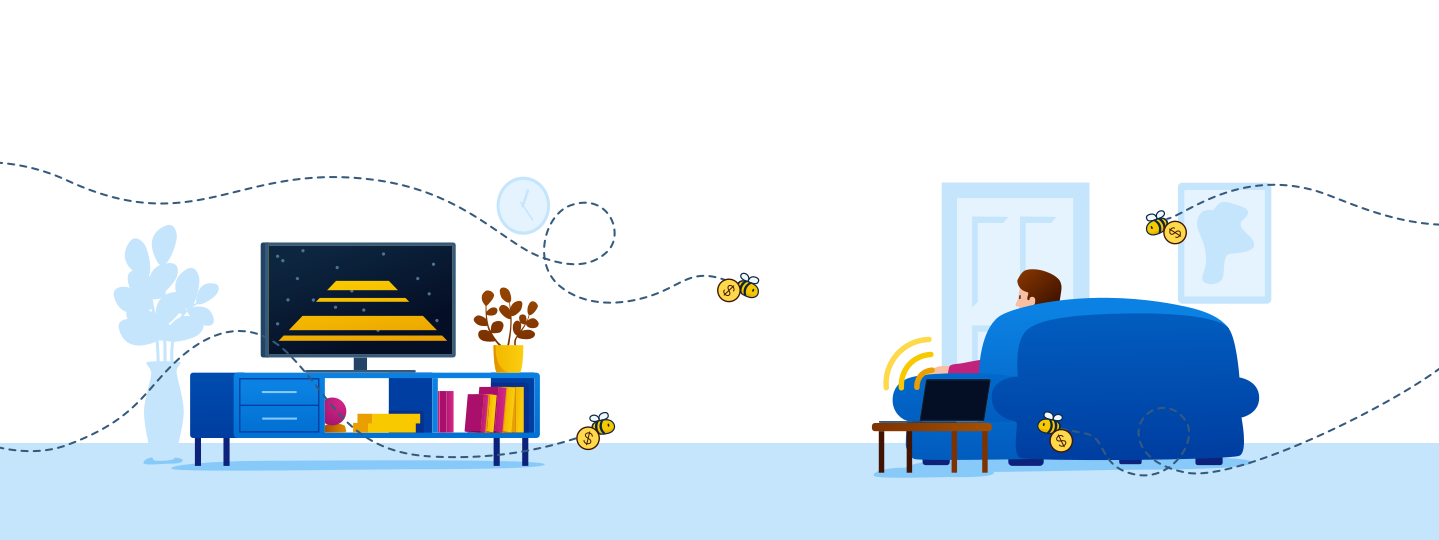
That unused capacity does not have to sit there doing nothing. If you have an extra amount of bandwidth to spare, apps like Honeygain let you share a portion of your unused connection with a crowdsourced web intelligence network and earn quietly in the background.
What is bandwidth sharing and is it safe
Bandwidth sharing refers to sharing the capacity of your internet connection. At home, you share that capacity with the devices and people using your network. Your phone, laptop, smart TV, and other smart home devices all use the same connection.
The term can also refer to sharing some of your unused bandwidth with a third-party network through a bandwidth sharing app.
In this case, the app uses part of your available connection while you continue using the internet, and pays you for the bandwidth you share.
When you share your own connection this way, you’re taking part in residential bandwidth sharing. You control your home connection, decide whether to share it, and can stop sharing whenever you want.
Public Wi-Fi is different. When you connect to Wi-Fi at a café, hotel, airport, or another public place, you’re using someone else’s internet connection and control nothing.
How bandwidth sharing apps like Honeygain work
Bandwidth sharing apps like Honeygain give you the opportunity to earn from part of your internet connection that you are not using.
You install the app on your device, leave it running in the background, and allow it to share a portion of your unused bandwidth with Honeygain’s network.
This gives Honeygain’s business partners a way to access publicly available websites and see what those sites show to users in your location.
For example, a company that tracks prices might use the network to check how much a product costs on different websites in different countries.
At the same time, a brand might use it to find counterfeit products or unauthorized sellers online, and so on.
Honeygain tracks the traffic you share and gives you credits based on how much bandwidth your connection contributes.
You can run Honeygain on Windows, macOS, Linux, and Android, so you can choose a supported device that fits your setup. You can also stop the app whenever you want and stay in control of when you share your connection.
How much you can earn depends on factors such as your location, internet connection, and how long you keep the app running.
One Reddit user who ran Honeygain on both a PC and mobile device reported earning 7,879 credits, or about $7.88, and said they were averaging 200 to 400 credits per day at the time of their post.
Earnings vary by user, so any figures you see should serve as examples rather than guaranteed results.
Is bandwidth sharing safe?
Bandwidth sharing can be safe when you use a trusted platform and understand what you’re agreeing to.
Before you install an app, check who operates it, what its partners use your connection for, and what security measures it has in place.
Look for encrypted connections and independent security checks. If you use a VPN, choose a reputable provider and keep your connection protected with encryption.
You should also check your internet provider’s terms before using any bandwidth sharing app. If your plan has a data cap, sharing bandwidth can count toward your monthly allowance, so keep an eye on your usage.
Most importantly, make sure the platform clearly explains who uses your connection and what they use it for.
Honeygain, for instance, does not access your personal files or browsing history. The app works with vetted partners, uses encrypted connections, and undergoes third-party audits to help protect your connection and data while you share bandwidth.
So, is bandwidth selling safe? Yes, it can be, as long as you choose a trusted platform, understand how it uses your connection, and check your ISP’s rules and data limits before you start sharing.
How to manage and monitor your bandwidth
To manage and monitor your bandwidth, check how much capacity you have, see what is using it, and make a few simple changes to get more from your connection.
1. Run a speed test
When measuring bandwidth, start by checking what your connection actually delivers. Use an online speed test and compare the download and upload speeds with the numbers in your internet plan.
Run the test at different times to get a clearer picture of how your connection performs when your household is busy versus quiet.
2. Check which devices use your connection
Open your router’s settings and look at the devices connected to your network. You may spot phones, TVs, computers, game consoles, or other devices you forgot were connected.
If one device is downloading large files, streaming in high quality, or syncing a lot of data, it could be using a large share of your available bandwidth.
3. Set up Quality of Service (QoS)
If your router supports Quality of Service (QoS), use it to decide which online activities get priority when your network gets busy.
You could give a video call, work computer, or online game priority over background downloads or updates.
This helps your most important activities keep running smoothly when several devices compete for bandwidth.
4. Decide what to do with unused capacity
Once you know how much bandwidth you have and how much your household actually uses, look at the capacity you leave unused.
If you have plenty of bandwidth sitting idle, a bandwidth sharing app such as Honeygain gives you one way to put some of that spare capacity to work while the app runs in the background. Selling internet data this way won’t replace an income, but it turns capacity you already pay for into a small return instead of letting it sit unused.
FAQs
What is internet bandwidth in simple terms?
Why does my internet feel slow even with high bandwidth?
Does more bandwidth make my ping lower for gaming?
Can I earn money from my unused bandwidth?
Related articles


Earn passive income effortessly
